Our TownFeaturing Jim Parsons, Zoey Deutch, Katie Holmes, Billy Eugene Jones, Ephraim Sykes, Richard Thomas, Michelle Wilson, Julie Halston, and Donald Webber, Jr.Ethel Barrymore TheatreSeptember 17, 2024 – January 19, 2025production […]
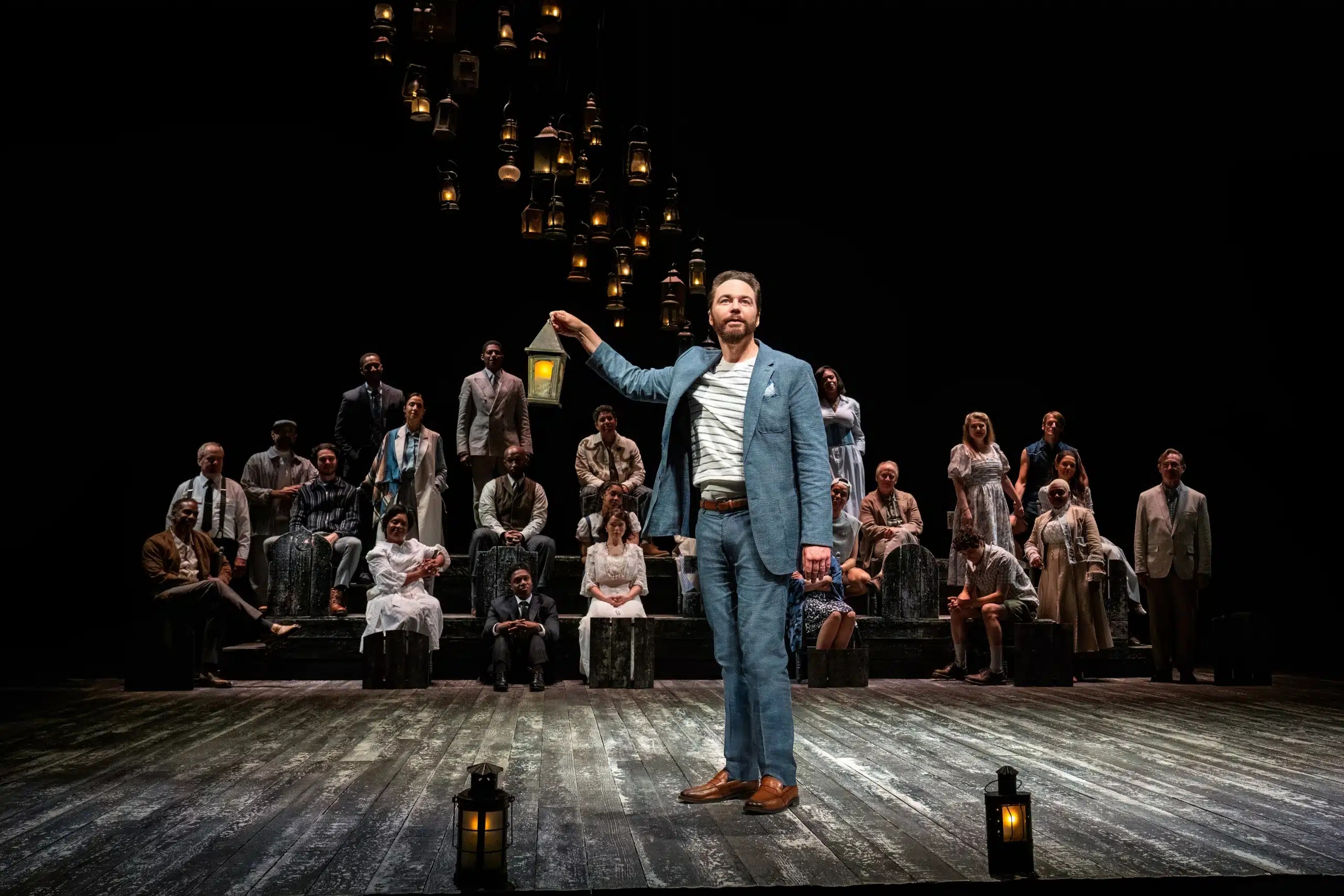
Jim Parsons and the cast of Our Town. Photo: Daniel Rader.
Our Town Featuring Jim Parsons, Zoey Deutch, Katie Holmes, Billy Eugene Jones, Ephraim Sykes, Richard Thomas, Michelle Wilson, Julie Halston, and Donald Webber, Jr. Ethel Barrymore Theatre September 17, 2024 – January 19, 2025 production site
The first act of Thornton Wilder’s 1938 modernist classic Our Town takes place in the fictional Grover’s Corners in the second year of the last century: May 7, 1901. Nothing much happens and that is precisely the point. Wilder brings us into the quotidian charms and resonant emotional yearnings of youth, of middle age, of death in a small town that is every town. Wilder tells a story of family life in a small town, when in fact he is telling a story of time as it passes, when it passes, allowing us to live in the moments and feel the frustrations of youth, exasperation and responsibilities of middle age, and resolution of late life and death.
The current revival is the fifth revival of the play since the 1938 original production (and of course there are hundreds of productions across the country and the world each year). Taking the helm is director Kenny Leon, who has with Estate permission made alternations, interpolated a multi-cultural procedural to kick off the enterprise, opted for race conscious or non traditional casting, crafting interracial marriages and relationships in early 20th century American life that challenges expectations. And the rapid fire, no holds barred, hang on we’re barreling through pacing of this quiet classic does no service to the resonance of the story.
Paper editor Web (Richard Thomas who is making a tremendous later life career playing avuncular characters often with a dark side), Mrs. Webb (a competent Katie Holmes), and children Emily our future bride (Zoey Deutch) and Wally (Hagan Oliveras) are white in this casting, while Dr. Gibbs (Billy Eugene Jones), Mrs. Gibbs (Michelle Wilson), and children George Emily’s future husband (Ephraim Sykes) and Rebecca (Safiya Kaijya Harris) are black. This production asks us not to wonder about a 1901 mixed marriage the future will find quite ordinary, and for the most part this works quite seamlessly.
The Stage Manager (Jim Parsons) enters after the Leon interpolation of a parade of prayers that is quite moving and led me to believe the alternations of the sense of the play would be more extensive, more expansive than casting choices. Other than casting, and rapid fire pacing, and the decision to remove all intermissions so that act breaks are announced (birth, marriage, death) rather than lived with opportunities to stretch, Leon has not in frac revolutionized or internationalized or multicultural-ized Our Town but rather sped it up, pared it down, adorned it with a few extra events. He does borrow from the resonant David Cromer revival of some years ago (that started in Chicago and landed in New York at the Barrow Street Theater where I caught it) the idea of introducing scents to the scenery, but where Cromer was parsimonious and carefully selective with this idea (he has Mrs. Giggs in Emily’s visit to her childhood from beyond the grave to see an ordinary day begin with mother frying up some bacon, and as that scent wafted through the audience you could feel the community of tears and communal spirit congeal) — Leon takes that idea and trebles it. There are different scents for each of the scenes including nonspecific flowers and others less discernible for Acts 1 and 2, and Cromer’s idea of the bacon frying smell for Act 3, Emily’s memory of family life breakfast.
This revival, in the end, can introduce newcomers to this essential American modernist work of art, enchant others, and frustrate even more like me. Leon’s direction is swift, unsentimental, functional, and the cast is more than competent, even splendid in a story of supporting characters. Standouts are Julie Halston as Mrs. Soames, a neighbor who sees everything when living and a fellow cemetery resident who speaks volumes by silently viewing the passing parade in the final Act. Billy Eugene Jones as Dr. Gibbs breaks your heart and feeds your soul, and the lovely and layered performance by Zoey Deutch as Emily, our young heroine who lives and dies and appreciates her family in the end.
Beowulf Borrit’s barnwood upstage wall and variously hanging (appearing and disappearing) lighting instruments, Allen Lee Hughes’ haunting lighting design, period costumes by Dede Ayite, and quite solid sound by Justin Ellington (all voices discernible in the sizable theater) serve this production and all its variously successful ideas.
On thing is certain: this play deserves to be and will be staged every year, multiple times a week, to different effects. This is our human story of people in community, finding a life and living it, and reflection upon it after our time is over.


 urban excavations