LiberationFeaturing Betsy Aidem, Audrey Corsa, Kayla Davion, Susanna Flood, Kristolyn Lloyd, Irene Sofia Lucio, Charlie Thurston, and Adina VersonLaura Pels TheatreJanuary 3, 2025 – March 2, 2025production site In a contender […]
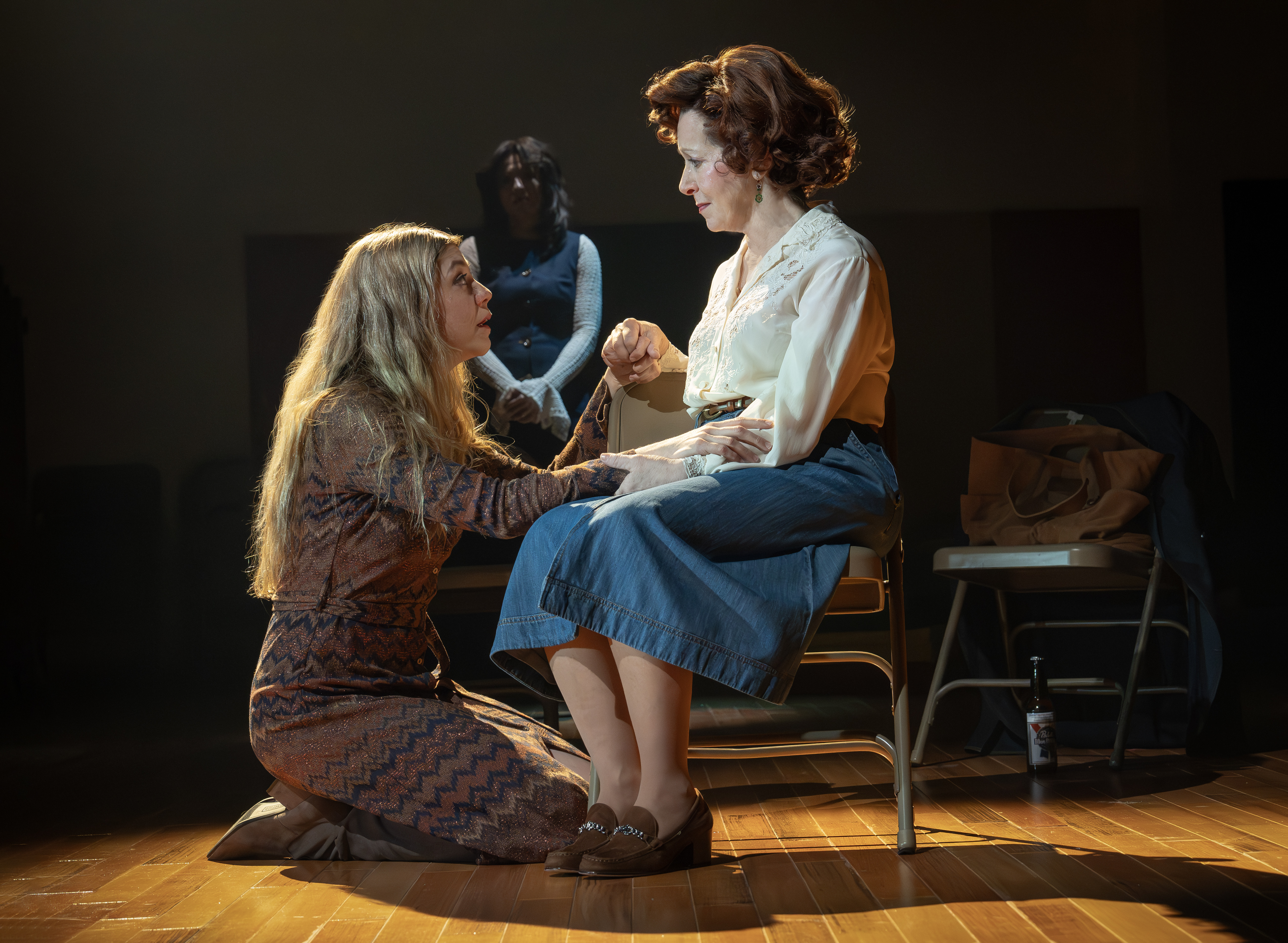
[L-R] Susanna Flood and Betsy Aidem, back Irene Sofa Lucio. Photo: Joan Marcus.
Liberation Featuring Betsy Aidem, Audrey Corsa, Kayla Davion, Susanna Flood, Kristolyn Lloyd, Irene Sofia Lucio, Charlie Thurston, and Adina Verson Laura Pels Theatre January 3, 2025 – March 2, 2025 production site
In a contender for a favorite play subtitle for a current favorite new play, Bess Wohl’s Liberation, a kind of love letter to her mother and the women she knew in the 1970s, is subtitled “a memory play about things I don’t remember.” We exist here, under Wohl’s expert playwright’s guidance, in 2025, a recent interstitial time unspecified, and the 1970s in which her mother convened a discussion group of wildly varying characters. This may or may not really be her mother’s story (how are we to know) and our narrator Lizzie (Susannah Flood) is and is not her own mother. It is the narrator who has forgotten what she’s trying to reclaim, revealing that Lizzie playing in the story both daughter and mother as Flood herself is playing both roles most of the time (have we lost you yet? Wohl keeps a firm hand on this storytelling, have no fear). Wohl explores what has been lost to memory, what has been lost to history, what we can reclaim in telling the stories of our mothers and sisters.
In Liberation there is enchantment, disappointment in paths not taken individually, mourning for misguided directions the country has taken. The 1970s portions of this play take place during a time when the fight for the Equal Rights Amendment was ongoing and hopeful, and that’s the least of the sources of pain for today’s audience. Time shifts continually in the play, not within scenes but around them, and in how they hand off to each other. Lizzie the mother is dead in our present and the adult daughter mourns the fact that she hasn’t asked her mother enough about her past, but she wants to dig into it, the politics her mother lived through, where the movements (civil rights and women’s liberation and anti-war protests) were current and before they lost their focus. The narrator swears she won’t be like her mother, but the narrator admits she didn’t get the straight story before her mother died. So this play is about memory that isn’t real (perhaps) but memory the daughter has pieced together. Even if she knew what her mother was into with her consciousness raising group women pals, hearing her mother recall events wouldn’t make them the work of an historian. This is a theatrical construction, always busy, always layered, telling a story but through untrustworthy narrators.
The plot-ish portion of this play involves the convening of an actual group in middle America begun by Lizzie’s mother. In 1970 or so, Lizzie began a consciousness raising group “somewhere in Ohio” in a community center that ran for five years. It began by Lizzie posting a simple flyer, drawing a disparate array of souls. Margie (Betsy Aidem) is middle-aged white mom, bored by her retired husband. Susan (Adina Verson) is living in her car, single Jewish activist who has been disowned by her family. Isidora (hysterical Irene Sofia Lucio) is in a green card marriage that landed her in Ohio but is yearning to make films and get politically involved. Celeste (Kristolyn Lloyd) is a black editor and writer who has returned to Ohio to care for her dying mother. Dora (Audrey Corsa) is a pretty white secretary who entered the group by mistake and embraced the message. Joanne (Kayla Lavion) enters at times too early or too late for the meeting to remind us that for single black mothers at that time, meetings during the day without childcare were actively excluding her and women like her. We watch Dora and Margie evolve in particular, white women of privilege of two different generations who find their political voices. And the group ends, we are shown (with Joanne asked by Lizzie to stand in for her with the male actor) when Lizzie’s father meets her mom and their romance begins, and mom marries and the group ends.
Somehow, beautifully and strategically, Wohl’s insistence on keeping us and Lizzie (the daughter) on our toes, not quite trusting any of these narrators of the proceedings as history, makes for enthralling theater. We see this world in the past through a veil of grief in the present, and even the memory of this dramatic feat by the actors, the creatives, and the playwright herself, brings me to tears even now after the fact. This is and isn’t about late stage feminism and its failures; this is and isn’t about how no woman can ever have it all and why was that ever even the goal.
Director Whitney White executes a fine calibration of this ensemble, layering their experiences and the time frames, allowing Wohl’s quirky structure to breathe. Qween Jean captures the era with painful accuracy — as someone who lived through that decade as a preteen, it was not a pretty looking era nor kind to any body type, and the costumes capture the times in all their post 60s oddball color combinations and bad materials and weird bodylines. Nikiya Mathis has executed a wide array of wigs that augment these characterizations beautifully.
Liberation is about what we can never know about the past and our parents’ lives and the world before. And it is glorious.
Playwright | Bess Wohl Director | Whitney White Set Design | David Zinn Costume Design | Qween Jean Lighting Design | Cha See Sound Design| Palmer Hefferan


 urban excavations