Trophy BoysFeaturing Terry Hu, Louisa Jacobson, Esco Jouley, Renita Lewis, Emmanuelle Mattana, and Imani RussellMCC TheaterJune 5, 2025 – August 3, 2025 [extension]production site What damage does elite education impose on […]
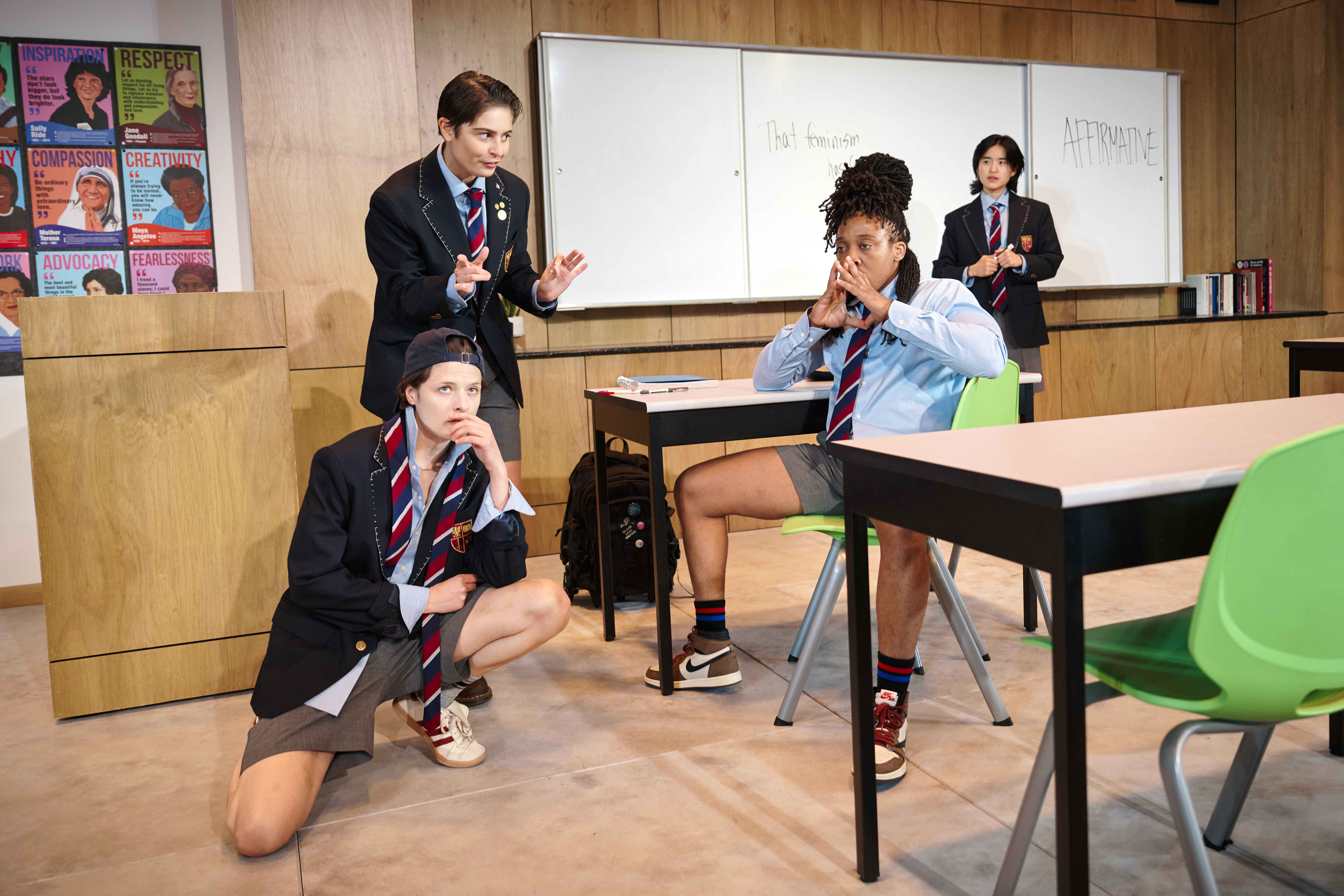
[L-R] Louisa Jacobson, Emmanuelle Mattana, Esco Jouléy, and Terry Hu. Photo: Valerie Terranova.
Trophy Boys Featuring Terry Hu, Louisa Jacobson, Esco Jouley, Renita Lewis, Emmanuelle Mattana, and Imani Russell MCC Theater June 5, 2025 – August 3, 2025 [extension] production site
What damage does elite education impose on young people in western society? Privilege brings responsibility some might say, to carry on traditions and norms and to support the institutions that raised them. Playwright Emmanuelle Mattana (she/they) is an Australian actor, writer, theater maker whose debut play arrives at MCC after touring Australia for a number of years. Mattana, from their website, has “a passion for telling stories that blend the playful with the political, and a love of young, queer audiences.” Let’s call this US premiere effort a resounding success.
Mattana’s play Trophy Boys, as directed by Danya Taymor the MCC Theater, is cast with four performers playing biological males — the playwright stipulates the teenage male characters be played by women, trans people, and non-binary actors. This stratagem proves provocative and layered, providing subtle commentary on the themes of the play itself and individual audience expectations.
The play is gender fluid, trans, sharp, hilarious, thought-provoking satire, bounding between comedic laughs and dance breaks to serious serious exploration of toxic masculinity and modern privilege. The plot of this 70-minute play, set entirely within the four cinderblock walls of a “well-off private girl’s school,” focuses on four debate male champions preparing to argue the proposition “Feminism has failed women,” in the affirmative against the debate team of a girl’s school where they are prepping their arguments.
Owen (playwright performer Mattana) has political ambitions to match his intense personality and politically-aligned opinions. Jared (Louisa Jacobson) aspires to a performance career, building on his good looks, aware that beauty works in politics as well as brains. Scott (Esco Jouléy) is an athlete focused on physicality and seeks comfort in his father’s political connections. Quiet but powerful David (Terry Hu) is the team advisor and nondebater, with parental connections to corporate interests.
Owen outlines two possible alternative strategies in their debate team’s approach. Argue that white feminism has not liberated minorities so it has failed, or forfeit the debate in “solidarity with our female and non-binary peers.” Owen is not out to win the argument or serious debate the issue but to impress the judges, the debate adjudicators, with the team’s political awareness. The boys on this team, as far as we can see, don’t believe in any position but are seeking to maximize benefits to themselves, ultimately seeking a scapegoat.
Director Taymor balances the serious revelations with choreographed shenanigans, enhanced by smooth moves and athletic stage actions choreographed by Tilly Evans-Krueger. The sound design by Fan Zhang is playful and energized, of the moment (even more so for those younger than I who recognize all the musical selections) and molds a specific world for these hormone-addled future patriarchs. Set design by Matt Saunders provides basic classroom functions and, following the playwright’s instructions, adorns the walls with bits of earnestness that provide their own commentary “posters of the girl-bosses of history on the walls” and and versions of “You Can Do It” encouragement to the girls whose classroom the boys are using for their debate prep. The details aren’t present to encourage the boys but to encourage the girls who typically hang at these desks.
There is plenty of plot packed into this play, perhaps upon retrospect a scheme, a design, a functionality to the plot pieces falling together. Taylor’s staging is calibrate and yet exhilerating, and several performances pull all the possibilities out of layers where they exist. Jacobson’s Jared has perhaps the flashiest role as an artistic jock who may aim higher than his intellectual capacity will deliver him. Mattana’s pragmatic Owen talks fast, thinks deep, displays anxiety, and we worry for him.
The plot plot twists of Trophy Boys mirror the decision points for adolescence and society as a whole. What is guilt and what is innocence and who gets to decide? How are successes measured and by what means are they achieved? This inaugural piece by a young writing talent is a worthy introduction to considerations of class and privilege and blackmail and power plays.
Playwright | Emmanuelle Mattana Director | Danya Taymor Set Design | Matt Saunders Costume Design | Márion Talán de la Rosa Lighting Design | Cha See Sound Design| Fan Zhang Movement | Tilly Evans-Krueger