Well, I’ll Let You GoFeaturing Quincy Tyler Bernstine, Cricket Brown, Michael Chernus, Will Dagger, Emily Davis, Danny McCarthy, Constance Shulman, Amelia WorkmanThe Space at IrondaleJuly 29, 2025 – September 12, 2025 […]
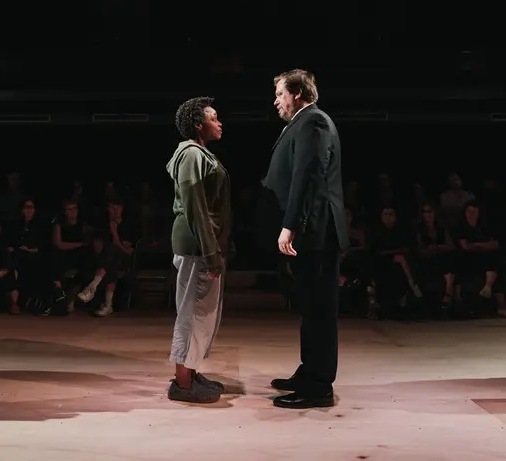
[L-R] Quincy Tyler Bernstine and Michael Chernus. Photo: Emilio Madrid.
Well, I’ll Let You Go Featuring Quincy Tyler Bernstine, Cricket Brown, Michael Chernus, Will Dagger, Emily Davis, Danny McCarthy, Constance Shulman, Amelia Workman The Space at Irondale July 29, 2025 – September 12, 2025 [extension] production site
In an unnamed Midwestern town (I’m from a midsized Michigan city myself so I crafted some possibilities in my mind, you can craft your own) that soon proves universal — the literal geography of Bubba Weiler’s Well, I’ll Let You Go soon melts away into the universality of grief and various paces of grieving, secrets and lies, survival and pragmatic commitment to carrying on. Midwestern characters pull up their socks (as my mother used to say) and carry on. We love the characters in this study of grief and resilience.
The structure appears at first glance to be a mystery played out in duets. We feel like the offstage detective observing revelations sequentially presented in layers of understanding as we get to know these understated Midwestern characters. Maggie (Quincy Tyler Bernstine) is at first the listener, the woman in whose kitchen friends, family, neighbors and others appear, speaking more of their concerns (as one does to a friend who always plays the role of confessor) than inquiring about her well-being. Through emotionally-dependent extended family to old friends to a funeral home employee (aha, bingo, the truth stone drops), we understand that we are observing a woman and a community in crisis, unearthing the sudden violent death of Maggie’s husband Marv.
Playwright Weiler plays with scale (vast and personal, intimate and expansive), and time frames (moving backwards and forwards), with one lasting big character-based plot reveal that should be left for each audience member to discover — not a total surprise if you’re paying attention, but a revelation that enhances the “ah” factor of this special play when experienced deep in the play’s final moments.
The story feels its way through pieces of an economically devasted manufacturing town and a few of its families that have suffered along the way. We first meet Marv’s widow Maggie in her kitchen with Wally (Will Dagger), Marv’s low-talking, paranoid, and hapless cousin, for what appears to be his usual hot meal and support from Maggie. Funeral home representative Joanie (Constance Shulman) provides characteristic stone-faced delivery of sensitive funeral arrangements and suddenly we understand what may have happened, if not the how or the why. Maggie’s friend Julie (Amelia Workman), all apparent concern but a few days late to Maggie’s side, reveals something about where Marv was when he died, which raises questions rather than providing answers. Plot falls to emotional content and we are riveted.
These are, in the end, a delicious series of character portraits and little subplots that suggest a richness of community lives, and that underscore the nature of community. We agree to commit to one another and believe in each other, through the secrets and the lies and revelations. Julie is tentative and scared (will her friend still love her?), Joanie the funeral representative is musing and funny and knowing and kind, Angela (Emily Davis), a stranger to Maggie, shows up after repeatedly calling after Marv’s death to talk about something only she knows that she wants to share. And Jeff (Danny McCarthy), Marv’s ne’er-do-well brother, is a bit baffled and bullying and holds a key to all the mysteries.
Thornton Wilder’s Our Town comes to mind quite quickly in the viewing of this play — its structure (a narrator) and the sequential storytelling, gradually revealing, and resolving in a story of people in community, making do. Our narrator (Michael Chernus) offers a simple throughline, assembling bits and pieces of the story as it proceeds, offering clues to wounds and secrets and expectations and off stage life of the people we have met.
The Space at Irondale, a performing theater in the belly of a church in Brooklyn, is a cavernous arena that struggles to hold this intimate story in a basketball court space. Designers work magic with the limitations of the dimensions — streams of white light where pertinent and dramatically powerful, a simple kitchen table, a refrigerator, a coffee pot, a few chairs, and some other furniture brought in to augment when necessary. For this production, it’s not the set, it’s the feeling. Credit to the masterful lighting design by Stacey Derosier making much out of a little, carving intimacy in a huge space.
Director Serio has crafted out of Weiler’s script an unbearably (but let’s be honest, this is precisely the kind of unbearable we want in theater) tender and yearning story that that haunts and resonates. This story of loss — of husband and dreams and community — is also one of re-committing to all of those things. Pour another cup of coffee. Sit down and stay with me a while. Let’s talk. And then I’ll let you go.
Playwright | Bubba Weiler Director | Jack Serio Set Design | Frank J. Oliva Costume Design | Avery Reed Lighting Design | Stacey Derosier Sound Design| Brandon Bulls Music | Avi Amon