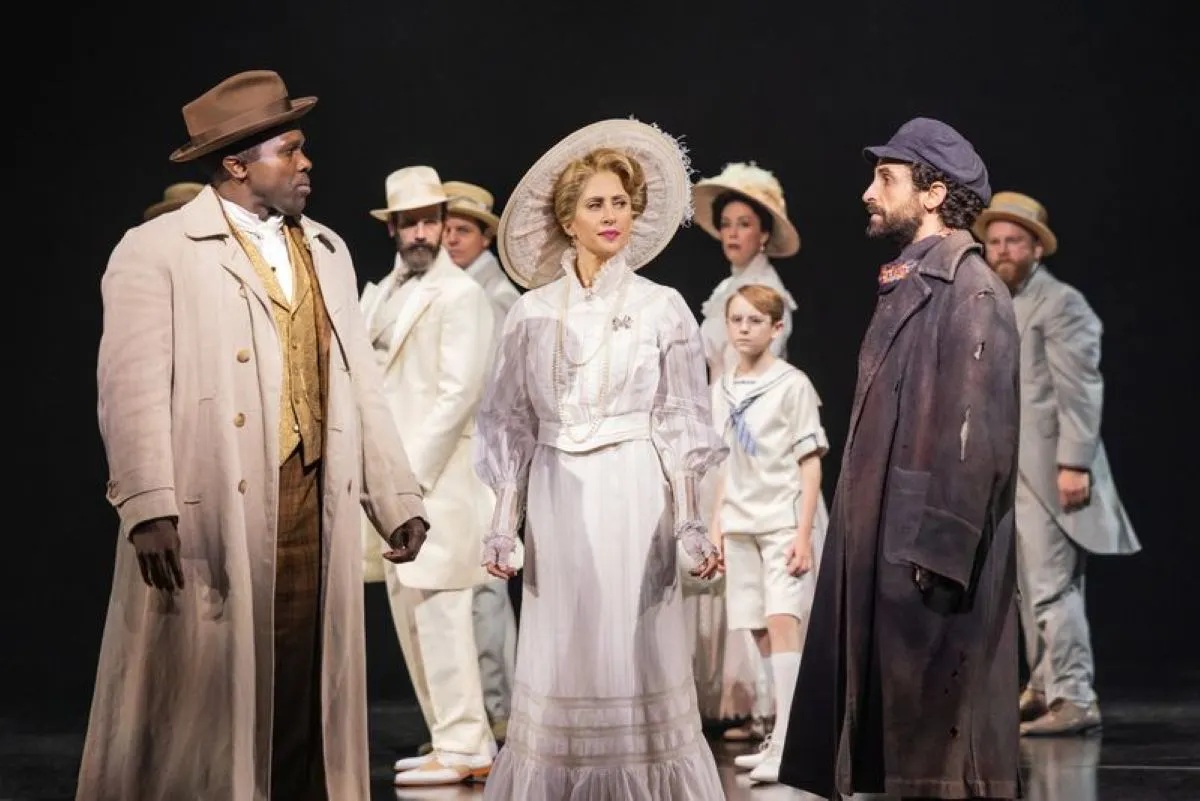
RagtimeFeaturing Joshua Henry, Caissie Levy, Brandon UranowitzLincoln Center Theater at the Vivian BeaumontSeptember 26, 2025 – August 2, 2026 [extension]production site There is a thrill to the sound of a big, […]
[L-R] Joshua Henry, Caissie Levy, and Brandon Uranowitz. Photo: Matthew Murphy.
Ragtime Featuring Joshua Henry, Caissie Levy, Brandon Uranowitz Lincoln Center Theater at the Vivian Beaumont September 26, 2025 – August 2, 2026 [extension] production site
There is a thrill to the sound of a big, ballsy Broadway orchestra full of strings and brass and all the trimmings. The new revival the 1988 musical Ragtime at the Vivian Beaumont Theater captures your heart from its first notes.
This first class production of Stephen Flaherty, Lynn Ahrens, and Terrence McNally’s Ragtime, elegantly directed by Lear deBessonet, lead by a trio of powerhouse performers with talents and skills perfectly matched to their characters — Joshua Henry as Coalhouse Walker, Jr., Caissie Levy as Mother, and Brandon Uranowitz as Tateh — capture huge swaths of American history at the turn of the 20th Century New York. Walker is a successful black musician driven by oppressive events to seek revenge, Mother is a fictional and repressed matriarch of a well-to-do WASP family in New Rochelle and Uranowitz is the Latvian Jewish street artist immigrant who immigrates with his young daughter and ends up in the movie business. Yes, fiction rules but the drama moves. The cast of sometimes nameless others expand the story (both in dialogue and beautiful music) to fill the entire Upper West Side outside the Lincoln Center campus.
The lives of the central trial characters and their families intersect with historical figures to entertaining effect. Emma Goldman (the ebullient Shaina Taub), and Harry Houdini (Rodd Cyrus) as well as the girl on the swing Evelyn Nesbitt (Anna Grace Barlow, playing piquant to perfection), augment the already packed population of this story. Within the story among the fictionalized characters, soap opera reigns amidst the direct hits at history. A young black woman Sarah (intense, a bit out of her element Nichelle Lewis) has abandoned her baby on the grounds of Mother’s estate, while her husband is on a long expedition, and Mother decides to take mother and child in, providing the connection to Coalhouse who is of course the father of the child, and one of many strands of the web that joins all these characters to one another.
Each of our main trio members has moments in the songbook sun. Uranowitz’s “Gliding” and “Our Children” (duetting with Levy) bring tears of joy. Levy’s “Back to Before” deep in the second act is a marvel. And wonder of Henry’s “Make Them Hear You” and “Wheels of a Dream” (duetting with Lewis) are marvels that stop the show.
David Korins has build a set that is spare and flexible (suggestive walls and dividers fly away), leaving the big wide Beaumont stage and Adam Honoré’s lighting to carry the smashing show design forward. Linda Cho’s detailed period costumes are thrilling, especially as lit by Adam Honoré. The orchestra has 28 pieces, supporting but not overwhelming the actors, who are heard throughout by Kai Harada’s clear and solid sound design.
This is an immigrant story, a redemption story, a story of the building of America. Hope reigns eventually for most, politics are brutal and some survive, characters reach across classes and raise children then did not give birth do and marry across religious lines. And golly, there’s hope for America.
As great stories that tell the history of the nation that hears them, this story, this version of Doctorow’s Ragtime as seen through a musical lens, allows the story to settle in your bones and in your heart. It is a transcendent revival for most and a solid and gorgeous introduction to this beautiful score and these performances for many others.
Playwright | Terrence McNally, adapting the E.L. Doctorow novel Music | Stephen Flaherty Lyrics | Lynn Ahrens Director | Lear deBessonet Set Design | David Korins Costume Design | Linda Cho Lighting Design | Adam Honoré Sound Design| Kai Harada Projection Design | 59 Studio