OedipusFeaturing Mark Strong and Lesley ManvilleStudio 54October 30, 2025 – February 8, 2026production site There is that clock — a gimmick or a heartbeat? In Robert Icke’s adaption of Sophocles’ tragedy […]
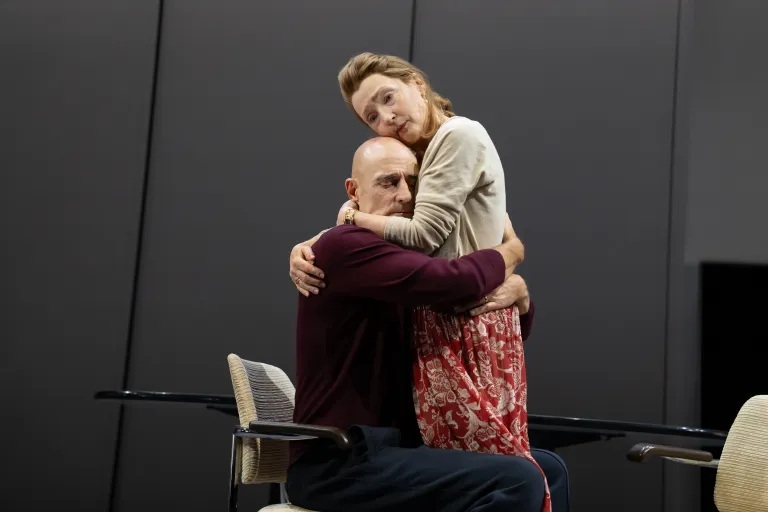
[L-R] Mark Strong and Lesley Manville. Photo: Julieta Cervantes.
Oedipus Featuring Mark Strong and Lesley Manville Studio 54 October 30, 2025 – February 8, 2026 production site
There is that clock — a gimmick or a heartbeat? In Robert Icke’s adaption of Sophocles’ tragedy Oedipus, we live the hope that things might change but the emotional knowledge that the end we know is coming will arrive, in this case in two hours precisely. The classic definition of tragic drama involves a story whose end in death and destruction you know is coming for a character, yet you as a reader or audience somehow become invested in a possible future for the doomed one. Here a clock ticks down in a contemporary world that is and is not Sophocles’ ancient setting of blinded sons and dead fathers and mothers. Tom Gibbons designed this clock’s sound that drives the heart of this play. And it is awesome.
Of course, a clock alone would not drive a play of several hours, however terrific the design. Here, newly elected leader Oedipus (Mark Strong) and his wife Jocasta (Lesley Manville) give brilliant performances of passionate spouses with pasts that will untether their present, leading a powerhouse cast that turn this ancient of story (with Icke’s tweaks) of family dysfunction and blind ambition into a contemporary cautionary tale.
Oedipus is a populist outsider with charismatic appeal, promising strength in leadership (points to video design by Tal Yarden for the on the street interviews with Oedipus and news coverage broadcasts providing political commentary, public statements, and the words that bring our handsome leader down), and certifiable parentage. True to the Greek original, Oedipus doesn’t know that he was adopted and his birth mother was a teenager and his adoptive mother was not his blood, and that his birth certificate was falsified. He promises to show his birth certificate in a political moment on air, going further than he must to show his bona fides, and his adoptive mother Merope (Anne Reid), the blind seer Teiresias (Samuel Brewer) can’t get his attention to call him off this fateful promise. At this point, wife Jocasta hasn’t realized that she met and married her son years later (he is some years younger than she but their passion and their several children are quite real and clearly born of love).
We experience all these revelations in theatrical real time measured by the count-down clock, in a set populated by family and attendants awaiting election returns on an election night. (What kind of leader election is being held isn’t made precisely clear but it could be mayoral or gubernatorial or regional leadership of some sort.) Oedipus’ young adult children come in and out, alternately spoiled and intelligent. His adoptive mother Merope and Teiresias, as noted, arrive to attempt to get Oedipus’ attention, but he is distracted and self-absorbed. And Oedipus and Jocasta, Strong and Manville, rarely leave the stage, speaking or resting at the side. We live for this adaptation in the backstage holding place, the left over green room at the tail end of an election campaign — furniture packed up around the edges but still a family meal assembled at point.
Oedipus, this Oedipus, is about a man who has already fallen, and the tragedy is about the realization you watch come over him of the folly of his off-the-cuff promise to provide his birth certificate (revealing the true story of his own birth and the horror of his relationships built afterwards). Perhaps the more profound tragedy in this adaption is watching the revelation of Jocasta’s past history and her realization that the life she has built with the child product of the violence she endured as a young girl. (Icke’s adaption touches on the extends the Greek original, giving us more of Jocasta’s backstory, providing Manville with some stunning monologues revealing her rape as a young teen and birth experience and the terror of it all.)
The set by Hildegard Bechtler is busy, full of side doors and mirrors and edges to hide behind and sit beneath. Lighting by Natasha Chivers is primarily corporate glare with loads of layers and nuances that occasionally subtly shine, as in several of Manville’s monologues, especially her final sequence that will break your heart.
This play’s two hours can feel like a moment and occasionally drag but in the end you reflect on the fact that you’ve lived a lifetime with these characters, in real time, with these characters. And it is horrific, in the best theatrical sense.
Playwright | Sophocles and Robert Icke (adaptation) Director | Robert Icke Set Design | Hildegard Bechtler Costume Design | Wojciech Dziedzic Lighting Design | Natasha Chivers Sound Design| Tom Gibbons Video Design | Tal Yarden