Anna ChristieFeaturing Michelle Williams, Tom Sturridge, Brian D’Arcy James, Mare WinninghamSt. Ann’s WarehouseNovember 25, 2025 – February 1, 2026production site We begin and end this story in the fog of a […]
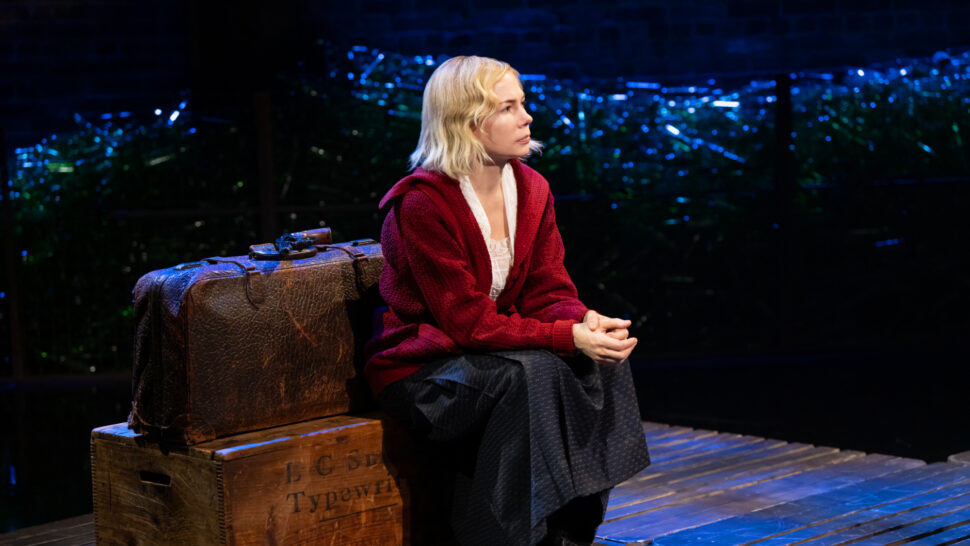
Michelle Williams as Anna Christie. Photo: Julieta Cervantes.
Anna Christie Featuring Michelle Williams, Tom Sturridge, Brian D’Arcy James, Mare Winningham St. Ann’s Warehouse November 25, 2025 – February 1, 2026 production site
We begin and end this story in the fog of a waterfront, as playwright O’Neill knew in his bones. The Monte Cristo cottage in New London, Connecticut where the playwright spent his childhood years (and commemorated in several of his plays) haunted him. Anna Christie and the St. Ann’s Warehouse production, is framed by life on the water, on the harshness of lives on the edge. O’Neill, himself the child of an immigrant (actor James was born in Ireland in the mid 1800s and son Eugene was born in New York City in 1888), writes with care about hard-hewn lives and two generations of new American lives, imported from another land. And these newly born American lives, enduring hardship on the windswept edges of the new-ish country, tell this tale of love and loss and hope for a future.
Anna (Michelle Williams) has grown up on a farm in Minnesota, sent there as an infant for a better life by her ship captain father Chris (Brian d’Arcy James). His ship is berthed in Provincetown, Massachusetts and Anna loves the stillness and the fog that Minnesota never gave her. Her tentative connection to father Chris (and his occasional friend-companion Marthy played with exquisite focus and clear-eyed gruffness by Mare Winningham) is tested by a man in distress in the water, a nighttime cry for help in the waves and fog. Mat (Tom Sturridge) is an Irish sailor, conveying danger and sex.
Anna, who presents herself as an erstwhile housemaid/nanny/house worker, in fact worked as a prostitute back in Minnesota and is hungry for this opportunity with her father and this new location to change her life. We gradually learn that she is in fact ill and needs to recuperate — is it TB or some other wasting disease? Only Marthy knows her backstory, and we know her relationship to Anna’s father, and suspect the plot machinations that may arrive from this.
Chris is kind and hapless and feels guilty that he surrendered his young daughter to Minnesota relatives (who mistreated her, so she left for her life on the streets) when his wife died and sees his quite adult daughter as the child he gave up. Anna is trying to take control of her life for this first time, weakened by illness and navigating the limited possibilities for a woman of limited means and no education at the turn of the 20th century. Anna as portrayed by Williams can speak tough and then try to temper her speech — much is achieved in this production with the nuance of diction and dialect, navigating broad midwestern vowels and lilting but gruff heavily accented Swedish-American English, and the Irish brogue of the shipwrecked sailor.
Anna wants to change her life but sees herself as marked by her past, and tempered by her wasting illness. Chris is addled with guilt and stalwart in his attempts to have built his own life. Mat is full of rage and ready to condemn the woman to whom his drawn. and both Chris and Mat have no ability to process the truth of Anna’s past life once she discloses it to them. This play is a time capsule of immigrant yearning and repressive social norms. The ex prostitute is adjudged by men, both Chris and Mat, who have visited prostitutes themselves but don’t suffer repression or judgment, internal or social.
The set (Christine Jones and Brett J. Banakis) encapsulates the show in a modular dance of deck pieces moved by the entire ensemble, wooden framing that could be a ships mast that becomes a bar’s surface, and always always the fog. Lighting by Broadway pro Natasha Katz catches edges of scenes, illuminates a wall of bottles at the back wall, radiates through the fog, and continually brings us close to the action in the expansive St. Ann’s production space. Paul Tazewell designed costumes that were class and culture specific and radiated sturdiness and slightly faded attempts at elegance — a working-class Sally Bowles in a few of Anna’s outfits pulled out of her small trunk.
And then there’s the fog. This is a time capsule of a play, indeed. And in this production, that capsule is framed deliciously.
Playwright | Eugene O’Neill Director | Thomas Kail Set Design | Christine Jones and Brett J. Banakis Costume Design | Paul Tazewell Lighting Design | Natasha Katz Sound Design | Nevin Steinberg