Death of a SalesmanFeaturing Nathan Lane, Laurie Metcalf, Christopher Abbott, Ben AhlersWinter Garden TheatreMarch 6, 2026 – August 9, 2026 [extension]production site Arthur Miller’s 1949 masterpiece of postwar identity reflection, Death […]
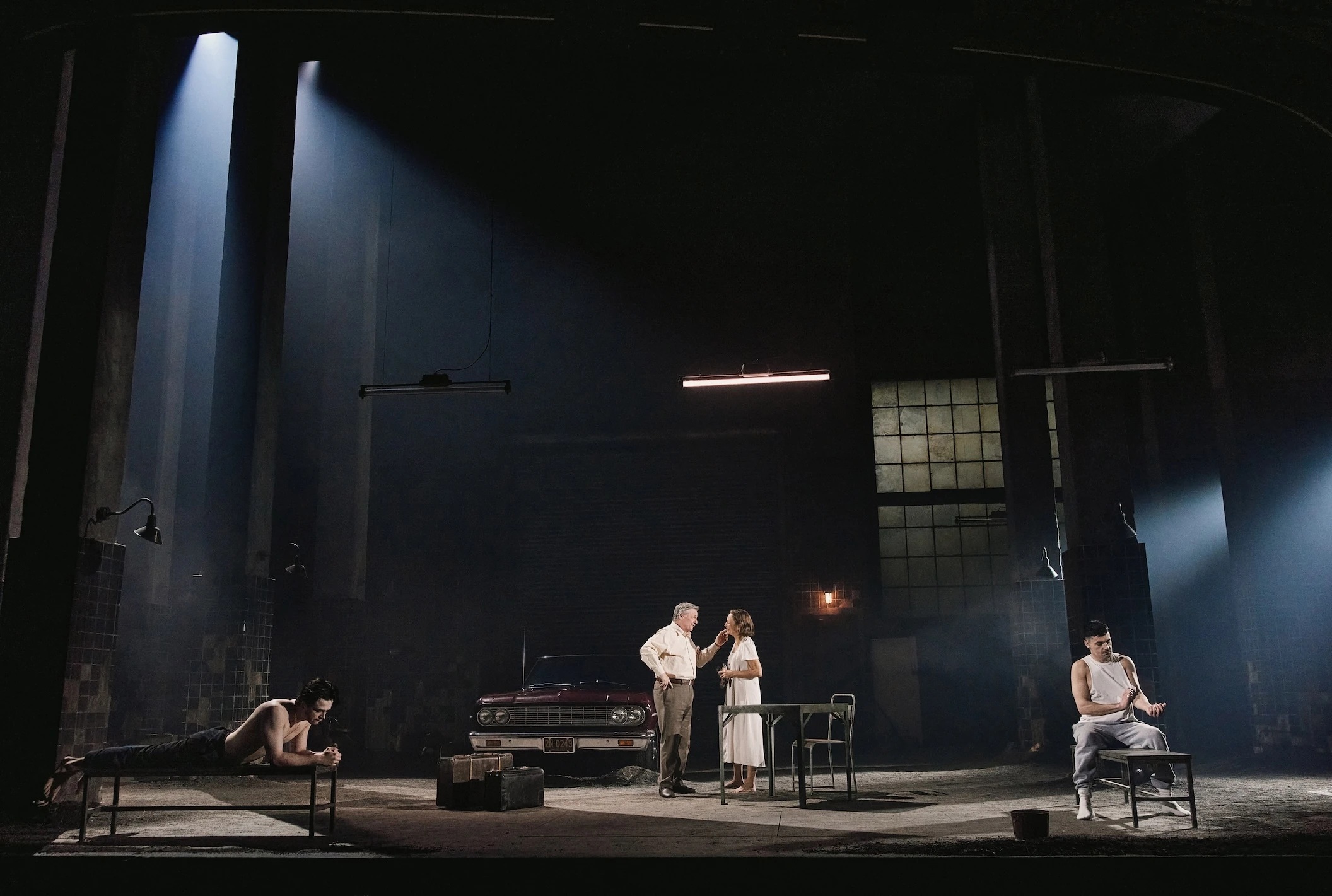
[L-R] Ben Ahers, Nathan Lane, Laurie Metcalf, Christopher Abbott, and the big dusty parking garage set. Photo: Emilio Madrid.
Death of a Salesman Featuring Nathan Lane, Laurie Metcalf, Christopher Abbott, Ben Ahlers Winter Garden Theatre March 6, 2026 – August 9, 2026 [extension] production site
Arthur Miller’s 1949 masterpiece of postwar identity reflection, Death of a Salesman, is a memory play part musing, part reality wake-up call, part nightmare, and part a contemplation of the individual’s disposable role in the corporate machine. This is a tragedy whose end beats are in the play’s title, but as a true tragedy, this production induces us to believe in our protagonist’s journey and the possibility that he might succeed. We are buoyed for a time by hope, share Willy’s disappointments, and never doubt the story’s outcome as it arrives. We are crushed.
Willy Loman (Nathan Lane) has spent decades as a salesman of unnamed widgets, on the road for weeks at a time, hired by the father of the current young man who runs the company and barely knows his name. Linda Loman (Laurie Metcalf) is his long-suffering wife of their two young adult sons, making do with the bare minimum, loving Willy despite his shortcomings, and insisting that “attention must be paid” to their father. Son Biff (Christopher Abbott) has a lurking resentment of his father that is revealed to be his chance viewing his father’s road infidelities some years before, and youngest son Happy (Ben Ahlers) is more accommodating, more wiling to go with the flow of mom and dad’s imperfections. Willy grapples with the dreams imparted to him by his rich and now deceased older brother Ben (charmingly handsome Jonathan Cake) who once offered him a chance to make money that Willy rebuffed. A long-term neighbor Charley (the always marvelous K. Todd Freeman) stops in, assesses the situation, and offers Willy a job to carry him over when his territory is continually cut, and Willy rebuffs him in confusion, and perhaps racism that is unaddressed but intriguing in this production. In the end, Willy takes his own life, the only logical outcome of this slice of life drama.
Director Joe Mantello takes Willy’s mental haze and made it manifest in the performances he has engendered (nuanced yet suggestive) and the marvelous set design by Chloe Lamford — Willy’s home and all the venues of the play are in corners of a cavernous garage set, that houses the massive midcentury car Willy has used on the road that arrives on stage at the top of the play and leaves the stage at the end. This is a luscious and literally concrete metaphor for a delicate and stolid American midcentury play.
Linda early in the play, when we still hope for Willy, calls to her sons to pay attention to their father, to honor him, and Biff and Happy grunt in agreement but don’t really understand what she is asking. In this American tragedy, we watch the fall of not a king or an emperor but a single working man who had a dream.
“I don’t say he’s a great man. But he’s a human being, and a terrible thing is happening to him. So attention must be paid.”
Lane’s engaging stage presence conveys the sense of being “well liked” that willy so craves, and that quality is held (sometimes to a monotonously singular note played) in this performance, a man baffled by his inability to entrance those around him with the jokes that once worked years ago. Time has passed him by and he has missed some steps by dropping deeper into a depression he doesn’t really track.
Biff was a star high school athlete, the challenge to many later in life, never finding his place, and Abbott finds in this character, as Metcalf finds her hers, the calm core from which he explodes later in the story when he confronts his father with the secret of his road trip liaisons that Willy never knew Biff knew. Ahlers presents Happy as the carefree but slightly jealous younger sibling who craves Dad’s attention — “you notice Pop?” — but isn’t crush when he doesn’t receive it.
But it must be noted that in this production, in this solid acting ensemble, the true revelation is in the non milquetoast, sufficient and loyal, fearsome and loving Linda portrayed by the wonder that is Laurie Metcalf. Her channeled focus on stage, ensemble and supporting and embracing, is awesome to behold.
It may be worth noting that for this writer, two particular starring performances this year in revivals or adaptations of classics — Lesley Manville as Jocasta in Robert Icke’s adaptation of Oedipus and now Metcalf as Linda in Death of a Salesman — resonate in productions in which they don’t explicitly upstage the other performers but challenge the very titles of the shows, suggesting we might be watching in these 2025-2026 productions Jocasta and Life of a Salesman’s Wife.
Lamford’s set is lit with beams and shadows by Jack Knowles reveal ruins and piles and corners and secrets. Are we in Willy’s head or in a suburban house or a corporate office or a salesman’s hotel room? Costumes by Rudy Mance are correctly period and a bit dumpy, Sound designer Mikaal Sulaiman creates an aural world that is clear and evocative, original music by Caroline Shaw evokes the time and yet creates a new world.
I have seen many versions of Death of a Salesman, most literally rooted in realistic sets and focused line readings. I learned more in the nuances and abstractions in this production than any I have viewed in the past. Hie thee.
Playwright | Arthur Miller Director | Joe Mantello Set Design | Chloe Lamford Costume Design | Rudy Mance Lighting Design | Jack Knowles Sound Design | Mikaal Sulaiman Music | Caroline Shaw